
Speckled Sussex chicken
A popular backyard chicken due to its gentle and friendly nature.
Is a dual purpose breed as it is good for both meat and egg production.
The Sussex comes in eight colours (Brown, Buff, Light, Red, Speckled, Silver, White and Coronation). The speckled variety is a rich mahagony colour with greenish black speckles.
Java Sparrow
A small bird at 15-17cm long, Java Sparrows live in flocks. Adults have distinct white cheeks, a black head, and a thick red bill. They have grey or fawn plumage and pink feet. They feed on rice fields in the wild and other seeds. You can visit these pretty birds in our aviary on the farm.
English Longhorn cattle
Meet our English Longhorns: Margot, Vienna, Wilma, Willow, Zeus, Zendaya, Zach and Zoe plus Gimli the Bull. You can find all of them in cattle shed.
English Longhorn is an ancient breed with large sweeping horns; it came close to extinction in the middle of the 20th century.
They are one of our largest native cattle breeds; with the cows (females) weighing 700-750kg and the bulls often over 1 tonne (1000-1100kg).
The body may be a variety of brindle colours but all have the characteristic white line along the back and down the tail. The horns usually sweep and curve forwards and as the name suggests can grow to great lengths. They are excellent mothers, give birth very easily and are docile and easy to manage.
In 2024 we welcomed our new, handsome bull to the herd – Gimli. In the video below, see our English Longhorns making their way back in the field. Follow our TikTok channel to see more fun videos of animals on our farm.
@rarebreedscentre All the cattle enjoying being in their field #longhorn #longhorns #cattle #fyp #fypp
Border Leicester Sheep
We were excited to welcome the Border Leicester sheep to the farm in 2024! These big, friendly sheep originally come from Northumberland. They are great mums and have super calm personalities. What makes them really special are their cute, rabbit-like ears that stand up and their Roman-shaped noses. They’re easy to spot and are often shown off at special events!
Their soft wool is also very special, as it’s shiny and takes dye really well, which makes it a favourite for spinners.
Find out more about Border Leicesters from the Rare Breeds Survival Trust’s (RBST’s) website.
Oxford Sandy and Black
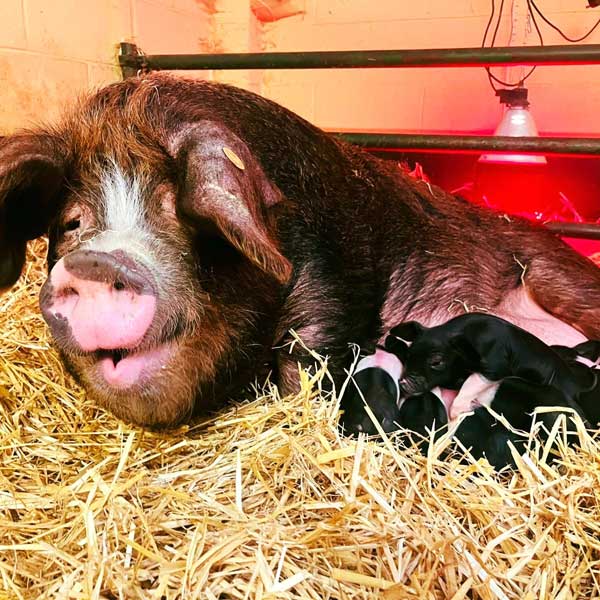
Meet Ivy and Fig, our Oxford Sandy and Black pigs! They are one of Britain’s oldest pig breeds. Known for their friendly nature, they have a special reddish colour that has earned them the cute nickname “Plum Pudding Pig”.
Sadly, this breed almost disappeared twice! But thanks to some caring breeders, they have been saved and are still around today, though there aren’t many of them left.
In July 2025, Ivy gave birth to her first litter!
This litter represents an exciting milestone for our farm team. Not only are Oxford Sandy and Blacks one of the oldest native British pig breeds, which are listed as ‘At Risk’ by the RBST, but Ivy’s piglets were born thanks to successful AI methods (artificial insemination), which is a first for our farm.
We can now actively help grow the population of these friendly “Plum Pudding Pigs” as they’re also known. without needing to find a male boar every time.
So it’s a big win for the breed, a happy time for Ivy who can now relax with her babies, and a proud moment for our farming team. Visitors are welcome to come and see Ivy and her piglets in the Children’s Barn. Remember to be calm and quiet around them so mum and babies can rest and bond in peace. You can see Ivy with her tiny babies in the YouTube video below.
In February 2026, Fig gave birth to 9 piglets!
We were delighted to welcome all 9 healthy babies. Visitors could come and enjoy them in the Children’s Barn.
British Alpine goat
Meet Guiness, our friendly British Alpine goat! You’ll find him in the Children’s Barn, and he loves visitors, so don’t be shy!
British Alpine goats are a large breed of goat with shiny black fur and white or creamy markings on their face and legs. If you look closely, you might see something funny on their chins. They have little dangly bits called toggles, something most goats have. Both boy and girl goats can have them. No one knows exactly why they’re there, but they might be leftover from a body part goats don’t need anymore!
Highland Bullock
Meet one of our most beloved animals on the farm: Huckleberry the Highland bullock. You can find him in the Children’s Barn.
Highland Cattle are known for their iconic ginger (orange) coats, though they used to come in other colors too! It’s said that Queen Victoria loved the red coat, so over time, more Highland cows became ginger instead of black. They come from the Highlands and Western Isles of Scotland and were first mentioned 1500 years ago!
These cows are great for helping with nature projects because they love to eat bushes and trees, which helps clear the forest floor and create meadows. Before coming to the Rare Breeds Centre, Huckleberry was a champion at the Kent County Show when he was only 6 months old!
They usually. have long horns and long wavy coats. Huckleberry doesn’t have the kinds of horns usually seen on Highland cattle, as he was de-horned as a calf. He arrived on the farm at 18 months old, from a local school farm, where he won a Champion rosette for their Young Farmers at the Kent County Show.